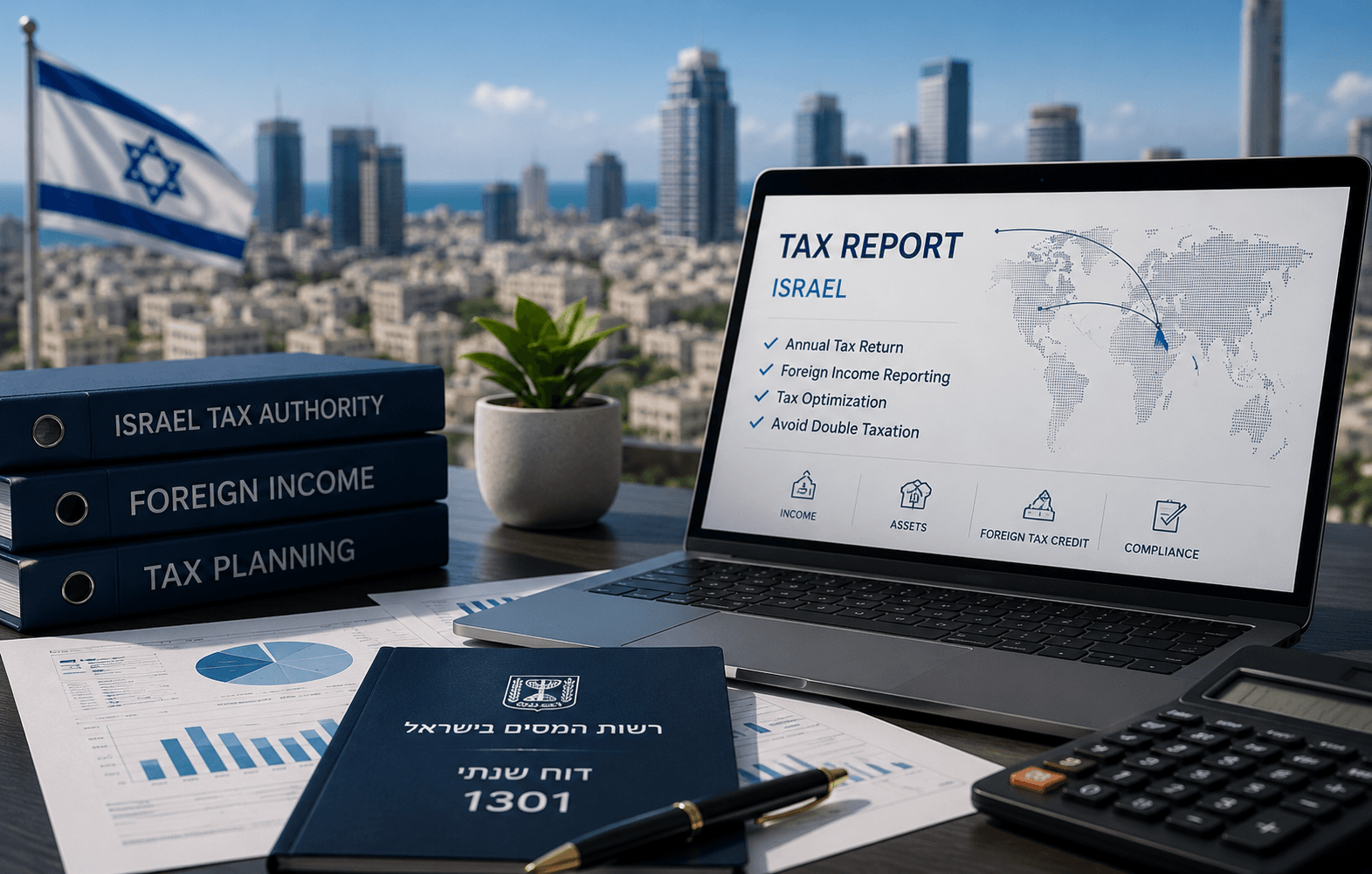

If you live in Israel, hold U.S. citizenship, invest in U.S. companies, or receive dividends in cross-border transactions between the U.S. and Israel, it is important to understand that the tax treatment is not always straightforward. In many cases, two countries are involved: the country where the dividend payer is located and the country where the investor is considered a tax resident. With proper professional advice, it may be possible to significantly reduce the tax burden and avoid costly mistakes.
The tax treaty between the U.S. and Israel may reduce the withholding tax rate in the appropriate circumstances. Eligibility depends on several factors, including the identity of the dividend recipient, how the investment is held, and whether the relevant Internal Revenue Service (IRS) forms were submitted on time and correctly.
For many investors, this issue may be relevant. For example:
- An Israeli resident who holds shares in a publicly traded U.S. company through a broker and receives quarterly dividends from the company.
- A U.S. citizen who lives in Israel and invests in both Israeli and U.S. companies that distribute dividends, while continuing to file tax returns in the U.S.
- An Israeli company that holds shares in a U.S. subsidiary from which it receives dividends.
In each of these cases, the taxation of the dividend should be carefully reviewed, because the answer may vary depending on the investor’s status and the investment structure.
When Can Dividends Be Taxable in Both Countries?
Generally, cross-border dividends may be taxable in more than one country. For example, a dividend paid by a U.S. company to an Israeli resident may be subject to withholding tax in the U.S., while also requiring reporting in Israel. The same principle may also apply in the opposite direction.
This does not necessarily mean that the same income will be taxed twice in full. Treaty relief, a foreign tax credit, and/or local tax rules may reduce the overall tax burden. However, investors should not assume that taxation applies only in the country where the dividend is paid.
Take, for example, an individual investor who is an Israeli resident, holds shares in a U.S. company, and receives a dividend from that company. As a rule, the U.S. withholds tax when the dividend is paid. At the same time, Israel generally treats that dividend as part of the investor’s taxable income. Whether the investor can benefit from treaty relief, or credit part of the foreign tax paid in the U.S. against the Israeli tax liability, is a question that depends on the specific facts and circumstances.
Withholding Tax Rates Under the Treaty: 25% generally
One of the most important practical aspects of the treaty is the limitation on the withholding tax rate imposed by the country paying the dividend. The treaty allows the source country to tax the dividend, but it limits the tax rate in appropriate cases.
For many individual investors and in many cases of ordinary cross-border holdings, the main treaty rate is 25% of the gross dividend. This is important because, without the treaty provisions, a U.S. payer may withhold tax at the default rate of 30%. Over time, this difference may be significant, especially for investors who receive ongoing dividend income from U.S. shares or holdings in private companies.
For example, if an Israeli resident invests directly in shares of a U.S. company and the treaty applies, the dividend will often be subject to withholding tax in the U.S. at a rate of up to 25% instead of 30%. However, the analysis does not end there, as the income may still be reportable in Israel.
Situation | Conditions | Withholding Tax Rate |
No treaty benefit | – | 30% |
Individual/entity – with treaty benefit | General holding | 25% |
Company – with treaty benefit | Holding of 10%+ + treaty conditions | 12.5% |
When May a 12.5% Rate Apply?
In certain circumstances, the treaty provides for a reduced withholding tax rate of 12.5%. This rate is intended for companies only, not for individual investors.
One important condition is the level of ownership. The recipient corporation must meet the treaty’s threshold requirement regarding share ownership, including the required holding period. To qualify for the reduced 12.5% withholding tax rate on a dividend distribution, the company receiving the dividend must hold at least 10% of the shares of the distributing company. This must be the case from the beginning of the tax year in which the dividend is paid, throughout the entire preceding tax year, if there is one, and until the actual payment date.
Another condition concerns the nature of the paying company’s income. The reduced rate for companies is not intended for structures in which too large a portion of the paying company’s income is passive income, such as interest or dividends, subject to the exceptions set out in the treaty. This is one reason why the 12.5% rate is generally more relevant to active groups than to purely passive holding structures.
For example, if an Israeli company holds a substantial stake of 10% or more in a U.S. subsidiary that conducts active business operations, and the treaty conditions are met, the company may be able to claim eligibility for a 12.5% withholding tax rate on dividends from the U.S. subsidiary. By contrast, if an Israeli individual holds publicly traded shares of a U.S. company through a personal investment account, the starting point for the analysis will generally be the treaty cap of 25%, not 12.5%.
Important Exception: Permanent Establishment Issues
The reduced withholding tax rates under the treaty do not always apply. For example, if the shareholding is effectively connected with a permanent establishment or fixed place of business that the recipient has in the other country, the classification of the dividend may change, and not necessarily in the taxpayer’s favor. The income may fall under the rules for business profits, which involve a different tax method than a regular dividend.
This issue is especially important for businesses operating across borders through a branch or another taxable presence, rather than through a separate local company. For example, if an Israeli company operates in the United States through a U.S. branch, and the relevant shares are attributable to that branch, the company may not be able to rely on the treaty’s ordinary withholding tax rates for passive dividends. Instead, the income may need to be analyzed under the rules that apply to business profits and permanent establishments.
Why Are W-8 and W-9 Forms Important?
In practice, achieving the correct withholding tax outcome often depends not only on the legal analysis, but also on filing the correct form with the IRS.
When a non-U.S. person seeks to claim treaty benefits with respect to U.S. source dividends, the relevant form will often be Form W-8BEN for an individual or Form W-8BEN-E for an entity. These forms are used to certify foreign status and, where appropriate, to claim treaty benefits. Without valid documentation, a U.S. payer may withhold tax at the default rate of 30%, even if the treaty allows a lower withholding tax rate.
However, this is exactly where many taxpayers make mistakes. U.S. citizens, green card holders, and other individuals who are considered U.S. persons (U.S. persons) under U.S. law should not submit Form W-8 to claim foreign status. They are generally expected to provide Form W-9. This point is critical for Americans living in Israel, dual citizens, and anyone who may be considered a U.S. tax resident.
Who Files | Appropriate Form |
Individual who is not a U.S. person | W-8BEN |
Non-U.S. corporation | W-8BEN-E |
U.S. person (U.S. citizen, green card holder, etc.) | W-9 |
Examples of the Correct Use of Forms
A common example is a U.S. citizen who has lived in Israel for many years and is considered an Israeli tax resident. From an Israeli perspective, that person may naturally view himself or herself as “Israeli,” but for U.S. tax purposes, he or she is generally still considered a U.S. person and will therefore generally provide Form W-9 rather than Form W-8BEN. Submitting the wrong form may lead to incorrect tax withholding, compliance issues, and unnecessary complications with brokers or financial institutions.
Similarly, an Israeli resident who is not a U.S. citizen, does not hold a green card, and is not otherwise considered a U.S. person may sometimes use Form W-8BEN to support treaty-based withholding tax treatment on U.S. source dividends. An Israeli company receiving U.S. source payments may need to consider Form W-8BEN-E, which is intended for entities. Before filing, however, the entity classification and treaty eligibility should be reviewed carefully, especially in more complex corporate structures.
TaxLink – Our Story
TaxLink is a CPA firm with a team specializing in both U.S. taxation and Israeli taxation. Our hands-on experience working with the U.S. Internal Revenue Service (IRS) and the Israel Tax Authority, together with a deep understanding of the interaction between the two systems, enables us to build an end-to-end solution tailored to your specific case.
Most clients who contact us do so because they are required to file U.S. reports – whether Form 1040, FATCA reporting, FBAR reporting, or reporting related to U.S. real estate investments. We manage the process as one coordinated cross-border matter, with the goal of reducing errors, avoiding duplication, and helping minimize double taxation, all within the framework of U.S. law, Israeli law, and the tax treaty between the United States and Israel.

FAQ
Can double taxation on dividend income usually be reduced?
Often, yes. Cross-border dividend income may be taxable in both countries, but the overall burden can sometimes be reduced through treaty-based limits on withholding tax, a foreign tax credit, and proper reporting in the country of residence.
What is the maximum withholding tax rate on dividends under the tax treaty between the U.S. and Israel?
In many cases, the treaty limits withholding tax in the source country to 25% of the gross dividend amount. A reduced rate of 12.5% may apply when the dividend recipient is a company that holds at least 10% of the capital of the paying company, subject to meeting the other conditions set out in the treaty.
Do Israeli residents always file Form W-8 to claim the treaty tax rate?
No. An individual who is not a U.S. citizen and is not classified as a U.S. person may sometimes use Form W-8BEN, and a non-U.S. entity may sometimes use Form W-8BEN-E. However, U.S. persons generally provide Form W-9. Therefore, Israeli residents who are also U.S. citizens, green card holders, or otherwise considered U.S. persons should verify their status before submitting any document to a bank, broker, or payer.
What happens when a person has ties to both Israel and the U.S.?
Situations involving ties to both countries are common. U.S. citizenship, a green card, the number of days spent in the U.S., and Israeli residency rules may all be relevant. The treaty includes tie-breaker rules for certain cases of dual residency, but they do not automatically eliminate all U.S. reporting obligations. Anyone with substantial ties to both countries should carefully review his or her status before relying on the treaty provisions or submitting W-8 or W-9 forms.