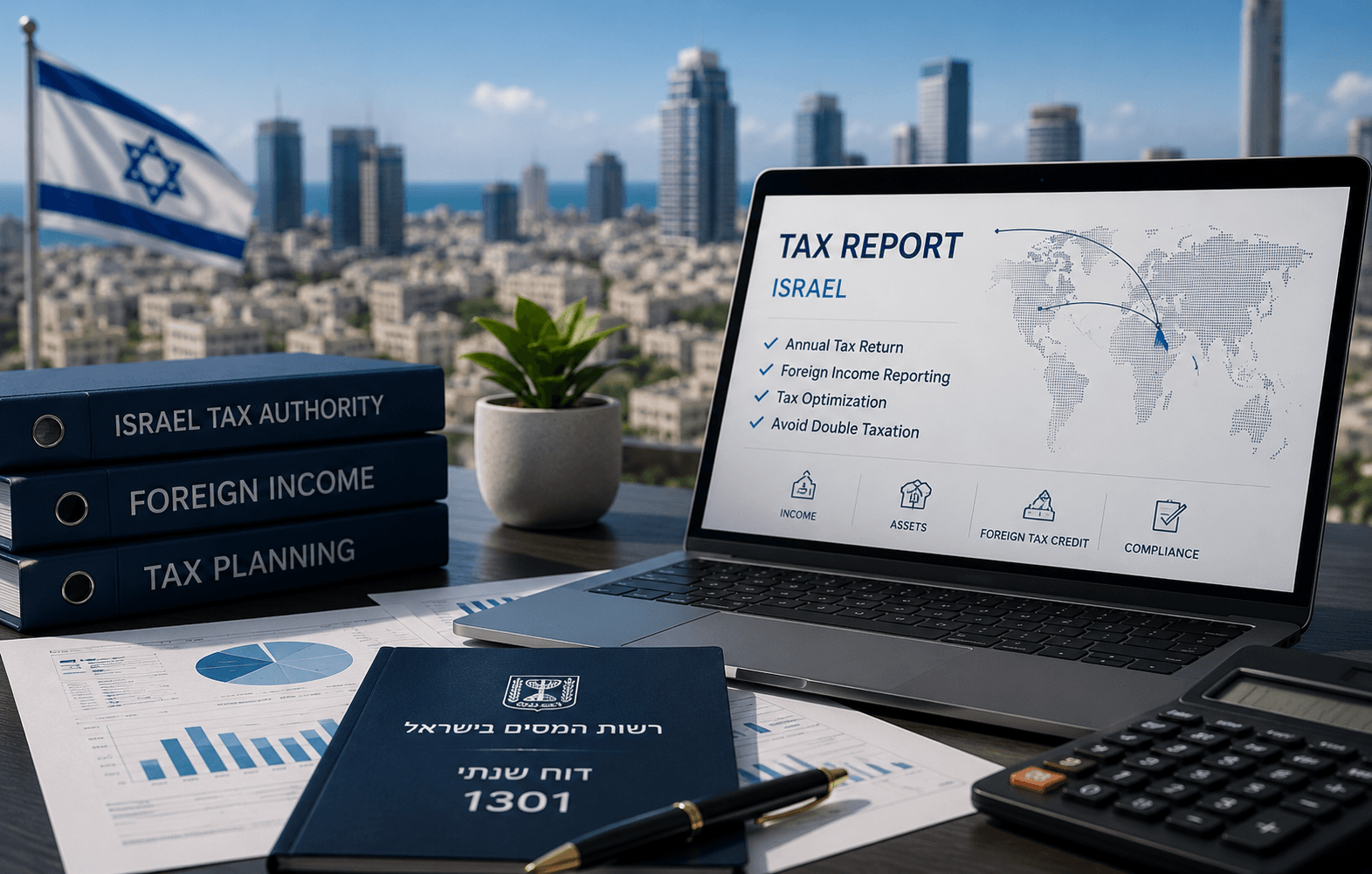

The new temporary order opens a significant window of opportunity for new immigrants and senior returning residents
For U.S. citizens considering moving to Israel, 2026 may be an especially important point in time. Moving to Israel has always required careful planning in terms of tax, reporting, and social security, but there is now an additional and highly significant development: the Encouragement of Immigration to Israel and Return to Israel Law (Temporary Order), 2026.
This is a new arrangement that, subject to certain conditions, grants an exemption from Israeli tax on qualifying income that was produced in Israel itself, and not only on income generated outside Israel, as many people are familiar with under the existing rules for new immigrants
Why is this particularly important now?
Because for U.S. citizens, moving to Israel generally does not sever the connection to the U.S. tax system. Put simply, even after becoming Israeli residents, they may still face U.S. reporting obligations and, in some cases, certain U.S. tax exposure, depending on the circumstances. As a result, any new Israeli tax benefit that reduces the local tax burden may materially affect the overall picture. Those who plan their move properly, review the type of income in advance, examine the employment structure, and consider the timing may achieve a far more efficient result than they would without advance planning.
What Changed Under the New Temporary Order for New Immigrants In 2026?
The central innovation of the temporary order is an exemption from Israeli tax on “qualifying income” that was produced or accrued in Israel, for new immigrants and senior returning residents who meet the eligibility conditions. This is a highly significant change, because for many years the focus was mainly on relief granted with respect to income generated outside Israel, while income produced in Israel, particularly employment income, generally did not enjoy similar relief.
The law provides that the benefit applies to a person who became an Israeli resident for the first time, or to a senior returning resident who again became an Israeli resident, during the period from November 5, 2025, through the end of 2026. Those who fall within this period may be eligible for an exemption from Israeli tax on qualifying income produced in Israel, subject to the caps set by law and its other conditions.
What Is “Qualifying Income” Under the Temporary Order?
Here it is important to pause and understand the definition, because not every type of income is included in the benefit. The law focuses on taxable income, that is income from personal exertion under sections 2(1) or 2(2) of the Income Tax Ordinance. Put simply, the focus is generally on income from employment, a profession, or personal services. On the other hand, the law expressly excludes certain types of income, including “other income” as defined in the Ordinance, as well as income attributed to a new immigrant or senior returning resident from a transparent entity, except in certain cases set out in the law.
The practical meaning is that it is not enough to know that you are a “new immigrant.” You also need to examine the source of the income, how it is classified, through what structure it is received, and whether it is in fact considered qualifying income for purposes of the benefit. People sometimes assume that salary, consulting fees, income received through a company, or payments from a particular business structure will all receive the same treatment, but in practice the legal and accounting distinctions here are critical.
What Are the New Exemption Caps for The Years 2026 Through 2030?
The temporary order establishes a graduated set of caps spread over several tax years.
- In 2026, the exemption cap is ₪600,000.
- In 2027 and 2028, the cap increases to ₪1,000,000 for each year.
- After that, the benefit is gradually reduced, so that in 2029 the cap drops to ₪350,000, and in 2030 to ₪150,000.
This structure sends a clear message: the legislature sought to create a meaningful incentive for moving to Israel and returning to Israel in the near term, while granting relatively broad relief in the first years. For families and professionals generating income from personal exertion in Israel, especially during the first years of establishing themselves, this is a benefit that may have very real value.
That said, it is important to note that in 2026 the exemption is calculated proportionately based on the period of Israeli residency during that year. In other words, those who become Israeli residents during 2026, rather than at the beginning of the year, will not necessarily receive the full annual exemption cap, but rather a proportional cap based on the length of time they were Israeli residents during that tax year.
What Happens When the Income Is Received from A Relative?
The law includes a special limitation where the qualifying income is received from a relative. In such cases, the preferential cap is not the same as the general caps. Instead of ₪600,000 or ₪1,000,000, a lower cap of ₪140,000 per year was set for each of the years 2026 through 2029. This is a provision that is very important to understand, because it applies to situations in which employment or engagement is with a relative, or within a particular family structure.
From a practical perspective, this is one of the areas in which inaccurate planning may lead to disappointment. Those who assume that all personal income in Israel will automatically qualify for the higher cap may later discover that the relationship between the parties materially changes the result.
Can The Benefit Also Apply Where the Activity Is Carried Out Through a Foreign Company?
Yes, but with great caution. The temporary order also addresses business income of a foreign-resident body corporate that was generated in Israel due to the personal exertion of a new immigrant or senior returning resident. Subject to certain conditions, such income may be exempt from Israeli tax. However, the law contains very important limitations.
For example, the benefit will not apply if the new immigrant or senior returning resident is a substantial shareholder in the foreign-resident body corporate. In addition, where a transparent entity is involved, the exemption will not apply to the portion of the income attributed to a rights holder who is an Israeli resident. In other words, the law recognizes that some immigrants continue to work through foreign business structures, but seeks to draw clear boundaries in order to prevent an overly broad interpretation.
For Americans who work with a U.S. company, hold a foreign entity, or continue to generate income through an existing U.S. structure, this is an especially sensitive point. It is not enough to know that there is a foreign company or a foreign client. You need to examine whether the exact legal conditions are met and whether the activity structure in fact makes it possible to benefit from the exemption.
How Do the New Tax Benefits Interact with U.S. Tax?
An Israeli tax benefit does not in itself eliminate U.S. reporting obligations. U.S. citizens generally continue filing U.S. returns even after moving to Israel, and in some cases also need to consider the use of U.S. mechanisms such as the Foreign Earned Income Exclusion (FEIE), foreign tax credits, or other coordination rules, depending on the circumstances. Therefore, the real advantage lies not only in reducing tax in Israel, but in creating an integrated plan that takes both sides of the picture into account.
Sometimes, when there is no advance planning, an inefficient result emerges: on the one hand, an Israeli tax benefit is missed, and on the other hand, the U.S. reporting is not structured properly either. By contrast, when the income classification, residency start date, work structure, and required documentation are reviewed in advance, it is possible to create a much more organized result and, at times, a much more tax-efficient one.
For Example: how can the temporary order affect things in practice?
Assume a U.S. software engineer moves to Israel in July 2026 and begins working from Israel for an employer that wishes to employ her under a structure that generates income from personal exertion in Israel. For illustration purposes only, her annual income is approximately ₪720,000 on an annualized basis, but because in 2026 she will be considered an Israeli resident for only part of the year, the proportional exemption cap for that year must be examined.
If it turns out that the structure does in fact meet the legal conditions and the income qualifies as qualifying income, then a substantial part of the income, or even all of the income relevant to the residency period, may enjoy an exemption from Israeli tax up to the proportional cap that applies to her. From that point onward, it is also necessary to examine the continuing U.S. reporting obligations and the way in which the U.S. reporting interacts with the Israeli result.
This example illustrates why it is not enough to know that there is a benefit for new immigrants. You need to understand exactly how it applies
How Do You Do This Properly?
The right approach begins before the move, not after it. First, you need to check whether the planned move date places you within the eligibility period established by the temporary order. Second, you need to examine the nature of the income and the way it is expected to be received in practice in Israel. Third, it is important to check whether there are family relationships, ownership in a foreign company, or other structures that could affect the application of the benefit.
Beyond that, for U.S. citizens it is especially important to create one coordinated plan that connects Israeli tax and U.S. tax. One of the most common mistakes is fragmented handling: one advisor in Israel, another advisor in the United States, and the client stuck between them trying to explain to each side what the other said. In that kind of reality, it is very easy to miss details, delay decisions, and create costly mistakes.
Tax Link – Our Clients
An American client who approached us before moving to Israel was very confused. He had heard that there were new benefits, but did not understand whether they applied to him, whether his income in fact qualified as qualifying income, and how all of this fit with the U.S. reporting he would in any event continue filing. In addition, he had several different professional advisors, and each provided only a partial answer.
At the first stage, we mapped out his income structure, moving date, employment arrangement, and exposure in both countries. We then built a clear action plan for him, including the sequence of steps, required documents, and full coordination between the Israeli and U.S. sides. Beyond the peace of mind this provided, the early planning helped him avoid costly mistakes and materially improve the overall economic result. That is exactly the difference between a move managed under pressure and a move managed properly.
In summary, the new tax benefits for new immigrants from the United States in 2026 may be highly significant, especially for those who generate income from personal exertion in Israel during the first years after moving to Israel. But this is not an automatic benefit, and it is not suitable for every income structure or every case. Those who want to make the most of it need to review in advance the moving date, the type of income, the relationships between the parties, the activity structure, and the reporting implications in both the United States and Israel.
At Tax Link, we handle your U.S. and Israeli tax matters from end to end, all in one place, with maximum professionalism and minimal involvement on your part, through a simple and efficient process. We are a CPA firm, with a team of professionals specializing in Israeli and U.S. taxation. The professional expertise we have built over the years in both countries, together with hands-on experience working with the Internal Revenue Service (IRS) and the Israel Tax Authority, and a deep familiarity with the wide range of issues you are likely to encounter, allow us to provide you with the best possible solution. We take into account the taxation in each country, and especially the interaction between them, in order to achieve the optimal tax result for you.
If you are considering moving to Israel and want full support before the move, now is the time to examine how the new temporary order may apply to you. An early review of eligibility, income structure, employment arrangement, and reporting implications can save costly mistakes and help you make the right decisions while there is still time. You are welcome to contact us for a strategic pre-move planning meeting, so you can understand what should be done now, while the available options are still open.

FAQ
Is every new immigrant from the United States automatically entitled to the new exemption?
No. Eligibility depends on the date on which you became an Israeli resident, the type of income, the employment structure, and whether all the conditions of the temporary order are met.
Does the benefit also apply to income produced in Israel?
Yes. This is one of the central innovations of the temporary order, because it may also apply to qualifying income that was produced or accrued in Israel.
Can you benefit from the exemption if you work through a foreign company?
Sometimes yes, but it depends on the activity structure, the ownership interest in the company, and whether the case meets the conditions and limitations established by law.
When should you start checking eligibility for the new tax benefits?
You should check before the move actually takes place, and preferably before any change in work structure, signing documents, or making significant tax decisions.